
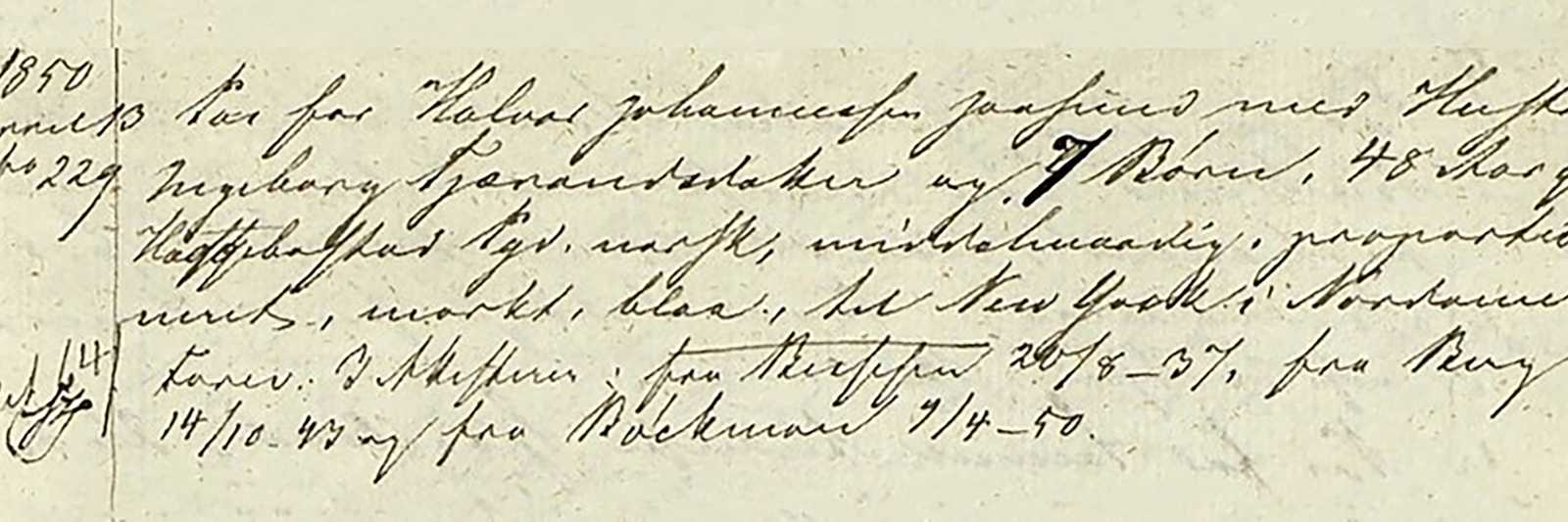
 Archival record: Statsarkivet i Stavanger, Jæren og Dalane fogderi, 46CA – Reisepass, transportordrer og diverse, Reisepass, transportordre 1828-1864, AV/SAST-A-100063/4/46CA/L0002
Halvor Johannessen: The Orphan Who Became a Family Man and Emigrated to America with His Wife and Children
In 1850, Halvor Johannessen and his family made the life-changing decision to leave Norway and seek a better future in America. But who was Halvor? Which sources can help us understand the man behind the name — and why he chose to leave the farm he had purchased in the early 1840s to start over across the Atlantic? What records reveal how the family prepared for the journey and what steps they took before departure?
The Halvor Johannessen Immigration Story begins in Norway and ends in America. This exhibit traces his journey — from tenant farmer to emigrant aboard the Ebenezer and life after arrival in Wisconsin.
Halvor Johannessen and his family were among the 78 passengers aboard the schooner Ebenezer when it set sail from “Dusevigen,” near Stavanger, in April 1850. Just before departure, Halvor received travel documents for himself, his wife Ingeborg, and their seven minor children. His eldest son, Johan, obtained a separate passport for himself and his wife, Karen Malene, whom he had married less than two weeks before the voyage.
Their destination was New York, with plans to settle in Wisconsin.
The passports describe Halvor and Johan in similar terms: both of medium height and average build, with dark hair and blue eyes. The entry for Halvor reads:
April 13, 1850, No. 229. Passport for Halvor Johannesen Jaasund with wife Ingeborg Tjærandsdatter and seven children, 48 years old, from Hægebostad parish, Norwegian, medium height and average build, dark hair, blue eyes, traveling to New York in North America.
The parish priest recorded that Halvor Johannessen, Ingeborg Tjærandsdatter, Johan and his wife Karen Malene Hansdatter, Marthe Oline (20), Ingeborg Helene (15), Karine (12), Gunnild (9), Ane Christine (6½), Halvor (4), and Carl Johan (1½) all emigrated to America in April 1850.
An Orphaned and Wandering Young Man from Agder
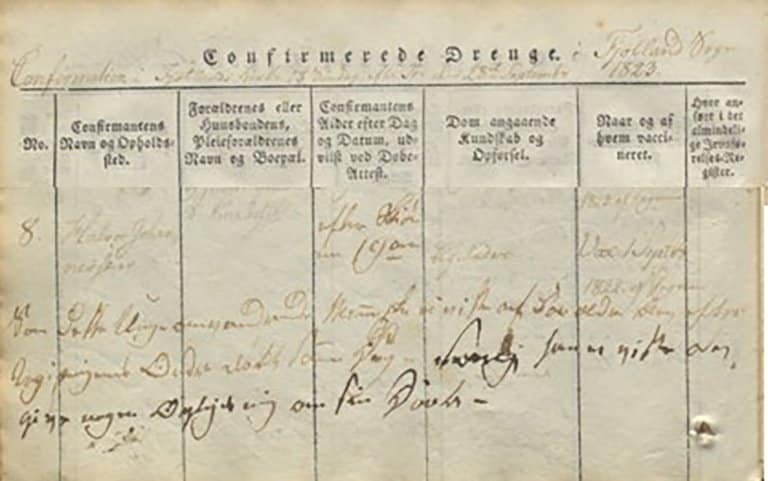
Archival records reveal little about Halvor Johannessen’s childhood. When confirmed in 1823, the parish priest estimated his age at 19 and noted that Halvor knew nothing of his parents — or even whether he had been baptized. Because there was uncertainty about whether he had ever been baptized, the priest chose to baptize him at the time of his confirmation.
A Young Laborer Who Built a Family in Rogaland
Two years after his confirmation, Halvor moved to Rennesøy in 1825. At the time, the parish priest noted that he was about 21 years old and working as a stone setter and blacksmith — skilled trades essential to rural communities. In 1826, Halvor married Ingeborg Tjærandsdatter, and the following year they welcomed their first child, Johan. At Johan’s baptism, the couple was listed as tenant farmers near Hausken Church in Hausken parish. They remained there when their daughter Martha Olene was born three years later. Tragically, she died died at age two in the summer of 1832. About six months later, another daughter arrived and was given the same name. Two and a half years later, Ingeborg Helene joined the family.
By the summer of 1837, the family of four had moved from Rennesøy to Eltervåg in Frue parish. At the time of the move, Halvor was still listed as a tenant farmer. After a few years at the croft known as Sletten — and now with another daughter, Karine — the family relocated to Jåsund in Håland (now Sola), where Halvor had purchased a farm.
A Farmer of Many Talents and Community Roles
While running the farm at Jåsund, Halvor and Ingeborg welcomed four more children: daughters Gunnild and Ane Christine, and sons Halvor and Carl Johan. Over 22 years of marriage, Halvor — who never knew his own parents —became the father of eight. He rose from tenant farmer to landowner and mastered several trades along the way. When he moved to Rennesøy in 1825, he worked as a stonemason and blacksmith. By the time he announced an auction for his farm 25 years later, he proudly called himself a master mason.
Halvor also held trusted roles in the local community. He served as a lagrettemann at two district court sessions in 1846. That same fall, he was appointed as a fire insurance assessor and soon began inspecting and valuing properties. This work likely provided a valuable secondary income —perhaps even helping to fund the family’s eventual journey to America.
Sale of the Farm
In the summer of 1849, Halvor decided to sell his farm. The following advertisement appeared in the Stavanger Amtstidende og Adresseavis:
A plot of land on the Jaasund farm in the parish of Sole, assessed at 1½ Spand Kornskyld, with buildings including a farmhouse, barn, cowshed, drying shed, and a small boathouse, together with 2 cows, 1 horse, various farming and fishing tools, and a fishing boat rated for 75 barrels of herring (approx. 9,844 liters / 2,600 U.S. gallons), fully equipped and seaworthy, is available for private sale by Halvor Johannesen of Jaasund.
It may have been around this time that Halvor and his family decided to emigrate to America. They were likely aware that a few other families from the area had already made the journey. Perhaps they had even seen the newspaper notice reporting that 75 people — six families among them—had departed for New York aboard the schooner Ebenezer that April. The year before, 60 others had done the same, including several families with children, all of whom arrived safely.
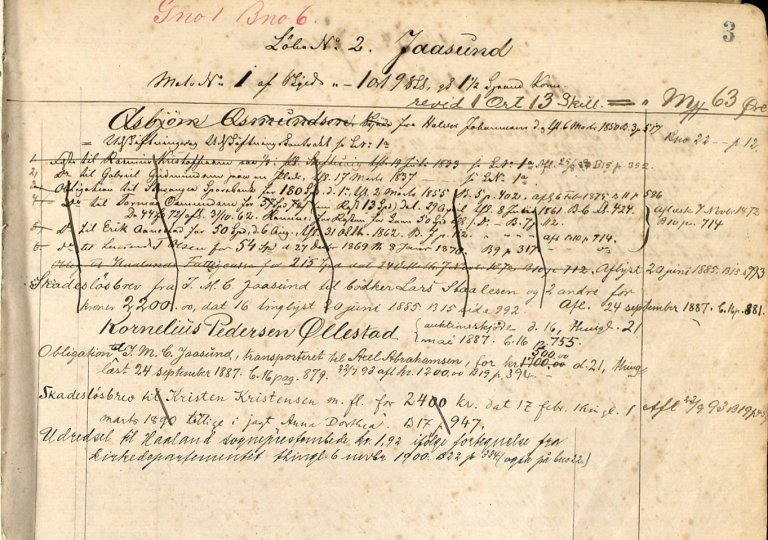
The sale of the farm took some time, but by March 1850, it was finalized. The deed registers both Halvor’s original purchase and the sale, officially recorded on March 6, 1850.
Auctioning Off Belongings
Once the farm was sold, it was time to part with the family’s belongings. Halvor contacted the district judge to arrange a public auction. The auction was announced in the Stavanger Amtstidende og Adresseavis several weeks in advance. On Saturday, March 9, 1850, the following notice appeared:
On Tuesday, April 2nd at 10 a.m., by request of Master Mason Halvor Johannessen, a public auction will be held at the Jaasund farm in the parish of Sole. Items to be sold include 2 cows, a 75-barrel sailboat, a quantity of oats, fishing gear, farming tools, and various household items. Terms will be announced at the auction.
District Court of Jedderen and Dalene, March 6, 1850.
As the ad shows, Halvor was not only a farmer but also a master mason. A wide range of tools were sold at the auction — not just farming equipment, but also shoemaking, carpentry, fishing, and blacksmithing tools. Among the household goods were a cradle, chairs, a baking table, rolling pin, and a baking oven with a matching pot. Clothing items like a sou’wester, oilskin jacket, and hat were also auctioned off. Several boats, barrels (some filled with grain), two cows, and even a hymnbook found new owners. In total, 212 items were sold for a combined sum of 144 speciedaler, 4 ort, and 15 skilling.
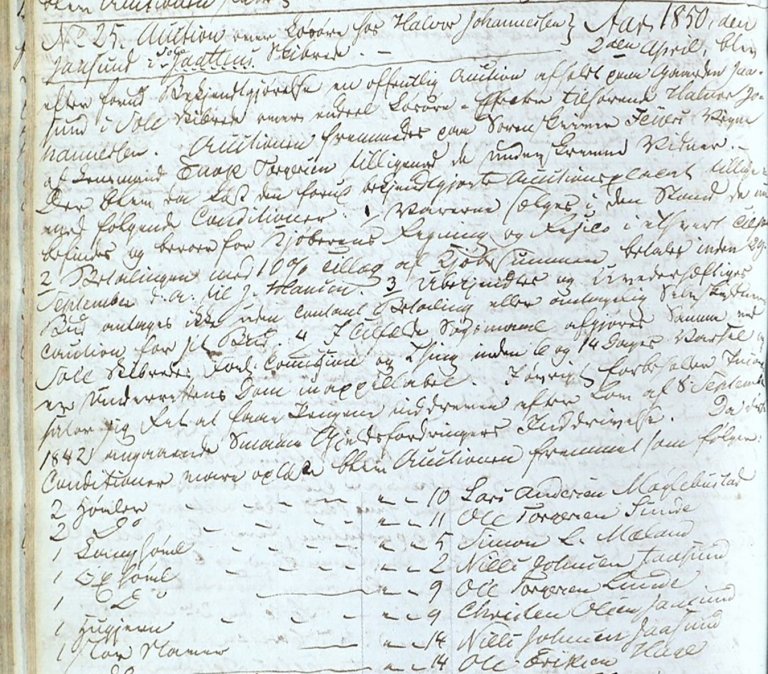
On April 2, 1850, following prior public notice, an official auction was held at the Jåsund farm in the Sole judicial district. The auction concerned a number of movable goods belonging to Halvor Johannessen.
The auction was conducted on behalf of District Judge Feyer by the local sheriff, Enok Torgersen, together with the undersigned witnesses.
The previously announced auction notice was read aloud, along with the following terms and conditions:
The goods are sold as-is and remain at the buyer’s own risk and expense under all circumstances.
Payment, including a 10% surcharge on the purchase price, is due by September 29 of the current year and must be paid to J. Hansen.
Bids from unknown or unreliable individuals will not be accepted unless paid in cash or backed by a credible guarantor.
In the event of legal disputes, these shall be resolved by the Sole District Conciliation Commission and Court (Sole Skibredes Forl.Comission og Thing), with 6 to 14 days’ notice. The lower court’s ruling is final and cannot be appealed.
Furthermore, the collector reserves the right to recover the funds in accordance with the Act of September 8, 1842, concerning the collection of small debts.
After these terms were read aloud, the auction proceeded as follows:
2 hand planes: 0–0–10, sold to Lars Andersen Møglebustad
2 more: 0–0–11, sold to Ole Torgersen Sunde
1 compass plane: 0–0–5, sold to Simon L. Mæland
1 bullnose plane: 0–0–2, sold to Niels Johnsen Jåsund
(…and so on) Archival reference: The Norwegian National Archives, The Regional State Archives in Stavanger, District Court of Jæren and Dalane, auction record for Jæren, 1847–1854, pages 305b–306a.
Press Interview With Halvor Before Boarding the Ebenezer
On the day of his departure, Halvor spoke with Stavanger Amtstidende og Adresseavis about why he was taking his family across the Atlantic. He spoke confidently about his work ethic and the opportunities he hoped to find in America. His optimism was grounded in experience: in Norway, he had risen from owning nothing to buying and successfully running a farm — selling it later at a profit.
Halvor had paid 300 speciedaler for passage for himself and his family and still had a considerable sum left over.
Halvor’s story, along with news of the Ebenezer’s voyage, was not only published in the Stavanger paper — it was also picked up by other newspapers, including Morgenbladet.
Newspaper Report: Stavanger, April 19
The schooner Ebenezer, Captain Clausen, from this town, is currently anchored at the outer harbor of Dusevig with 78 passengers, including 23 children, preparing to depart for New York. This is the vessel’s third voyage carrying emigrants to America. Among the passengers are three from Hardanger, two from Mandal, and the rest from the parishes of Strand, Torvastad, and Sola, as well as four families from the town itself.
From the parish of Håland is a man named Halvor Johannesen Jaasund, traveling with his wife, seven children, an adult son, and daughter-in-law. We mention this as a notable case, as to our knowledge, this is the first family to emigrate from Jæren.
But the man is not entirely a Jæren farmer; about twenty years ago, he leased a plot under the Rennesøy parsonage, which he cultivated and improved so well that he later sold it at a profit. He then cleared and developed another piece of land inland, and eventually purchased a property near Hafrsfjord, which he also cultivated and sold at a significant profit.
After paying over 300 speciedaler for passage, landing fees, and transport to Wisconsin, he still had nearly 100 speciedaler left.
This man, now 48 years old, has — despite having a large family and starting with nothing — worked his way up through farming and land development. He deserves to be recognized as proof of what diligence and hard work can accomplish. He now leaves his homeland, believing that if he could achieve so much here, he might do even better in America.
(Stavanger Amtstidende, reprinted in Morgenbladet, April 27, 1850)
Newspaper Advertising
According to notices in Stavanger Amtstidende og Adresseavis, this was the third voyage to America for Captain Clausen and the schooner Ebenezer. The paper mentioned the journey several times:
To America
Departing, God willing, in April: our well-known, fast-sailing, copper-sheathed schooner Ebenezer, Capt. H. C. Clausen, who has made this same voyage in each of the past two years. Both captain and vessel have earned the full satisfaction of their passengers.
Those wishing to take advantage of this excellent opportunity are encouraged to register and pay a deposit as soon as possible.
— L. & S. Svendsen
What We Know About the Crossing
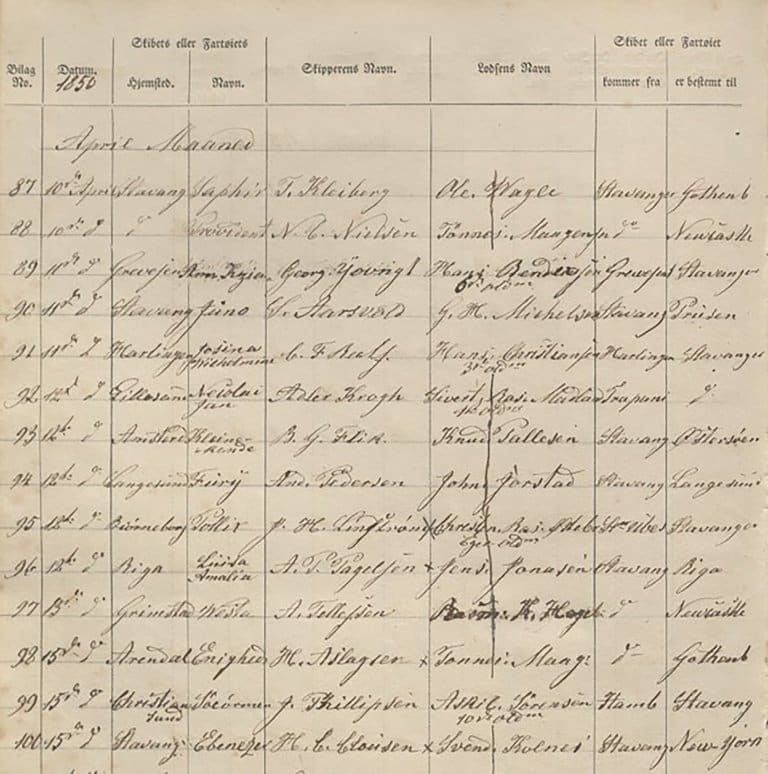
We don’t know exactly how Halvor and his family personally experienced their voyage across the Atlantic. However, archival records shed light on several aspects of the journey. According to the Stavanger Pilot Master’s Log, the schooner Ebenezer departed from the harbor at Dusevigen in April 1850, bound for New York. The captain was H. C. Clausen, and the pilot was Svend Kolnes.
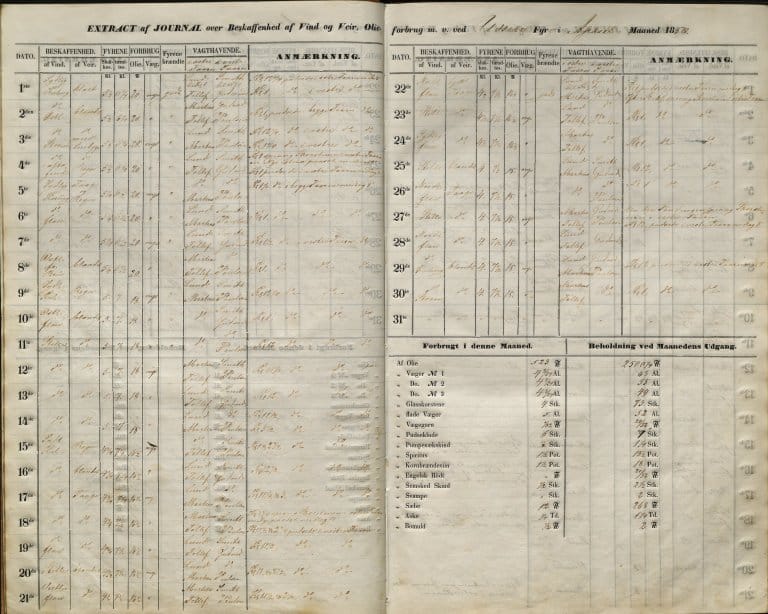
Weather Conditions Documented at the Utsira Lighthouse
Around the time of departure, the weather was foggy with a strong southerly gale. The watch log from the Utsira Lighthouse for April 1850 notes fog on the 17th, 18th, and 19th of April, while the weather on the 20th was more variable. The wind was recorded as “light” on April 19, but in the days prior it was described as a southerly gale.
Customs Records and Provisions
According to records from the Stavanger Customs Office, 75 passengers were cleared through customs with clothing and provisions. The Ebenezer also carried butter supplied by the trading house P. V. Rosenkilde & Søn, along with two barrels of salted pork.
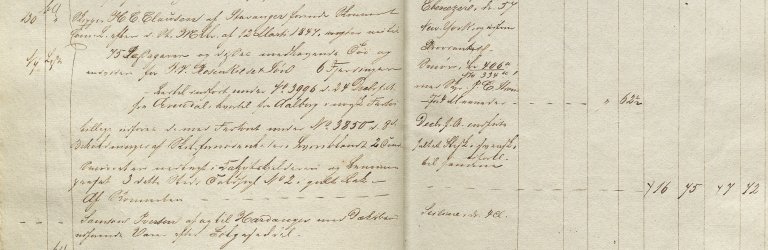
From the Customs Register:
Captain H. C. Clausen of Stavanger, commanding the schooner Ebenezer (57 register tons), commissioned in Lester, St. Michael’s on March 12, 1847, is now bound for New York. He is transporting 75 passengers along with their clothing and provisions. Additionally, for P. V. Rosenkilde & Søn, he is exporting six firkins of butter and two barrels of salted Swedish pork. The butter was stored in the cabin cellar, sealed with three local customs seals in yellow wax.
News of the Crossing
Interest in the transatlantic voyage was high, and several newspapers reported on it. Shortly after departure, a new voyage was announced for August — provided there was enough demand:
Stavanger, April 18, 1850
Our schooner Ebenezer, Capt. H. C. Clausen, which has now departed for America with emigrants, we intend to send on another such voyage this year, provided he completes this journey successfully and a sufficient number of passengers sign up for the second, which we hope can take place at the beginning of August.
— L. & S. Svendsen
On June 14, under Shipping and Trade News (Skibs- og Handels-Efterretninger), the paper reported:
Stavanger, June 14
The schooner Ebenezer, Capt. Clausen, which departed from here on April 20 with emigrants, arrived in New York on May 14 — after a voyage of approximately 24 days.
Four days later, a front-page article confirmed the Ebenezer’s safe arrival in New York. The crossing had gone well overall, with favorable winds, though the final leg brought rain and storms — and tragically, an eight-week-old girl died.
Detailed Account of the Voyage
The Stavanger newspaper offered a vivid account of the Ebenezer’s Atlantic crossing — detailing its swift progress, encounters at sea, and even a tragic loss during the voyage. It also described the ship’s arrival in New York and the onward journey inland.
Published in Stavanger Amtstidende og Adresseavis on June 18, 1850:
Stavanger, June 18
The Ebenezer departed Stavanger on April 19 and passed Feil Hull at midday on April 21. Winds shifted to south-southeast with consistently fair weather, so the topsail remained set for the entire Atlantic crossing. The Ebenezer overtook several vessels heading in the same direction.
On May 1, the ship sailed close by a dead whale. By May 5, they had reached the Newfoundland Banks—covering the distance from Norway in just 15 days, which was considered rare. Thick fog followed, but favorable winds continued for several days.
From April 19 to May 9, they enjoyed nearly uninterrupted good winds. Then came a storm with westerly winds and rain, lasting the remaining 100 miles of the journey.
On May 12, Jens Vixe’s eight-week-old child died and was buried at sea the next afternoon in a specially made box, accompanied by prayer and hymns.
On May 14, they took on a pilot and, with the help of a steamship, reached New York that evening. By May 16, all but two passengers had left the city. Captain Clausen accompanied them to Albany, where they boarded a canal boat to Buffalo for their exclusive use. The steamboat to Albany carried 1,600 passengers, and three such vessels operated daily between New York and Albany.
A crossing as swift as this one by the Ebenezer was considered quite rare.
Return to Stavanger
After completing its emigrant voyage to New York, the Ebenezer made a remarkably quick return to Stavanger. The July 2, 1850 edition of Stavanger Amtstidende og Adresseavis reported on the ship’s arrival and the cargo it brought back.
The locally owned schooner Ebenezer, Capt. Clausen, which departed in April with emigrants bound for New York, returned yesterday. She left New York on June 10 and completed the return voyage in just 21 days. The ship had favorable weather throughout, with only one day of headwind. The vessel carries a full load, consisting mainly of tar, resin, syrup, and rice.
We have not yet consulted American archival records or newspapers to learn what became of Halvor and his family after they settled in the United States. However, according to Norwegian Immigrants to the United States: A Biographical Directory, Volume V, 1825–1850, the family lived in several locations across Wisconsin. After spending a few years in Jefferson County, they moved to Two Creeks in 1853 and then to Two Rivers in Manitowoc County in 1855. Halvor and Ingeborg reportedly remained in Two Rivers for the rest of Halvor’s life.
Family Name in America
In America, Halvor went by Halvor Johannsen, though upon arrival he was registered as Holvor Johanneson. He died in May 1864, and his occupation was listed as fisherman. His wife, Ingeborg — known as Inger Johanneson —passed away sometime in the 1880s, reportedly while living in the Dakota Territory. The exact location is unknown, but their daughter Gunnild is said to have moved to Minnehaha County in the 1880s, and their son Johan had relocated to Swan Lake in the same area in the mid-1870s.
All of the daughters replaced the surname Halvorsdatter Jonsrud with Johanneson, and the sons replaced Halvorsen with Johanneson.
What Became of the Children
Marthe Oline – The eldest daughter is not mentioned further in the records.
- Ingeborg Helene – Married William Stone in May 1853. They had four children and settled in Carlton Township, Kewaunee County.
- Gunnild – Married Erik Enochsen from Rennesøy in 1856. They eventually settled in Schuyler, Colfax County, Nebraska, and had a daughter named Emli Maria (possibly more children). In the 1880s, they moved to Minnehaha County, Dakota Territory.
- Karine and Ane Christine – Both sisters married the year after Halvor’s death. Karine wed Thomas Peterson in Two Creeks, Wisconsin, in 1865, while Ane Christine settled in Iowa, where she and her husband, Nils Nilsen, had a son named Henrik Edward and possibly more children. Hedberg and Naeseth do not list any children for Karine and Thomas, though that does not necessarily mean they had none. The dates and places of death for both sisters remain unknown.
- Halvor (son) – Became a farmer in Two Creeks, Wisconsin, and married Sigrid Mikkelsdatter Hedalen from Østre Slidre. They had many children. Halvor died in 1896, and Sigrid lived until 1927. Both are said to be buried at Sandy Bay Cemetery.
- Carl Johan – Little information is available about the youngest son.
- Johan (eldest son) – Newly married when the family emigrated in 1850, became a farmer in Two Creeks, Wisconsin, and chose to call himself John Johnsen. His first wife, Karen Malene, died young in the summer of 1854 and was buried at Manitowoc Cemetery. Johan was left a widower with three or four small children. In 1855, he remarried Gunvord Thorkildsdatter Haaland in Green Bay, and together they had nine children.
Johan’s Later Life
During the American Civil War (1861–1865), Johan served in the infantry, in Company K, 21st Wisconsin Regiment. In the 1870s, he and his family moved to Swan Lake, Dakota Territory, where they remained until the early 1890s. They then relocated to Turner County, South Dakota. Johan’s final place of residence was Port Angeles, Washington, where he and his family settled in 1893. He died there in 1900.
This digital exhibition was created by Synnøve Østebø (Archivist) and Ine Fintland (Senior Archivist).
The article was originally written in Norwegian and translated into English using Copilot, based on the prompt: “Translate idiomatically for an American audience. The article will be published on the website of the National Archives of Norway. Use terminology appropriate for a U.S. readership, and ensure the language is clear and concise.” The final version was reviewed and edited by Ine Fintland and Kayla Marie Tungodden (Senior Advisor) for clarity and accuracy.